Forge Local
An AI agency for local businesses, designed from a blank page: brand, site, and the demo that closes the sale.
A brand, a demo, and a business, designed from a blank page.
Forge Local builds AI voice agents, chatbots, and websites for local businesses. In April 2026 it was an idea, a co-founder, and one constraint. By summer it had a brand, a marketing site, a voice agent you could talk to in your browser, a calculator that turns missed calls into dollars, and paying clients with live sites.
No ad budget and no marketing team. This page has to do the convincing before anyone picks up the phone.
The call comes when nobody can pick up.
The founder had sold roofing. He knew the pattern: a storm rolls through, every phone in the county rings at once, and the crews that could answer are on ladders. Each missed call is a job that goes to whoever picked up. We started there, with roofers and HVAC in storm season, because the pain was concrete and the math was brutal.
Missed: 0 calls · roughly $0 in jobs that went somewhere else.
Then the realization that widened the company: it wasn't a roofing problem. Barbers, bars, mechanics, and real estate offices all lose the call they can't take while they're serving the customer in front of them. The product stayed the same, an agent that answers every call and books the job, and the audience became every local business with a phone.
Local owners don't buy "AI." They buy the call they didn't miss.
Decision one: start with the layer that unblocks everything else.
Eight weeks to launch, and the only inherited decision was dark mode. Most brands start with the logo, which is where you lose a month arguing about a mark. I started with color, because color touches everything and unblocks everything downstream: once the palette had jobs, the voice followed, then the site, then every page after it. The logo got a quick placeholder so the site could ship, and it's being properly redesigned now; that was a deferral, not an oversight. What came out of the eight weeks is the system below, built once and meant to be iterated on rather than redone.
Forge Local
Be the name they know.
Warm, direct, a little bold. Written for a business owner reading on a phone between jobs. Short sentences. Dollar figures over adjectives. One thing to do on every screen.
Redesign in progress. The wordmark ships with the next revision of this document.
Pricing, designed to be understood.
Pricing is where design either earns trust or loses it. The CEO built the commercial model, four tiers, each stacking on the last; my job was making a stranger understand it in one look and know which one is theirs. The best-value tier sits in the middle rather than the top, because the goal is the right fit, not the biggest number. And every card carries a time to live, 48 hours, 7 days, 2 to 3 weeks, because the complaint we heard on nearly every call was months spent waiting on a developer. That was our edge, so the page leads with it.
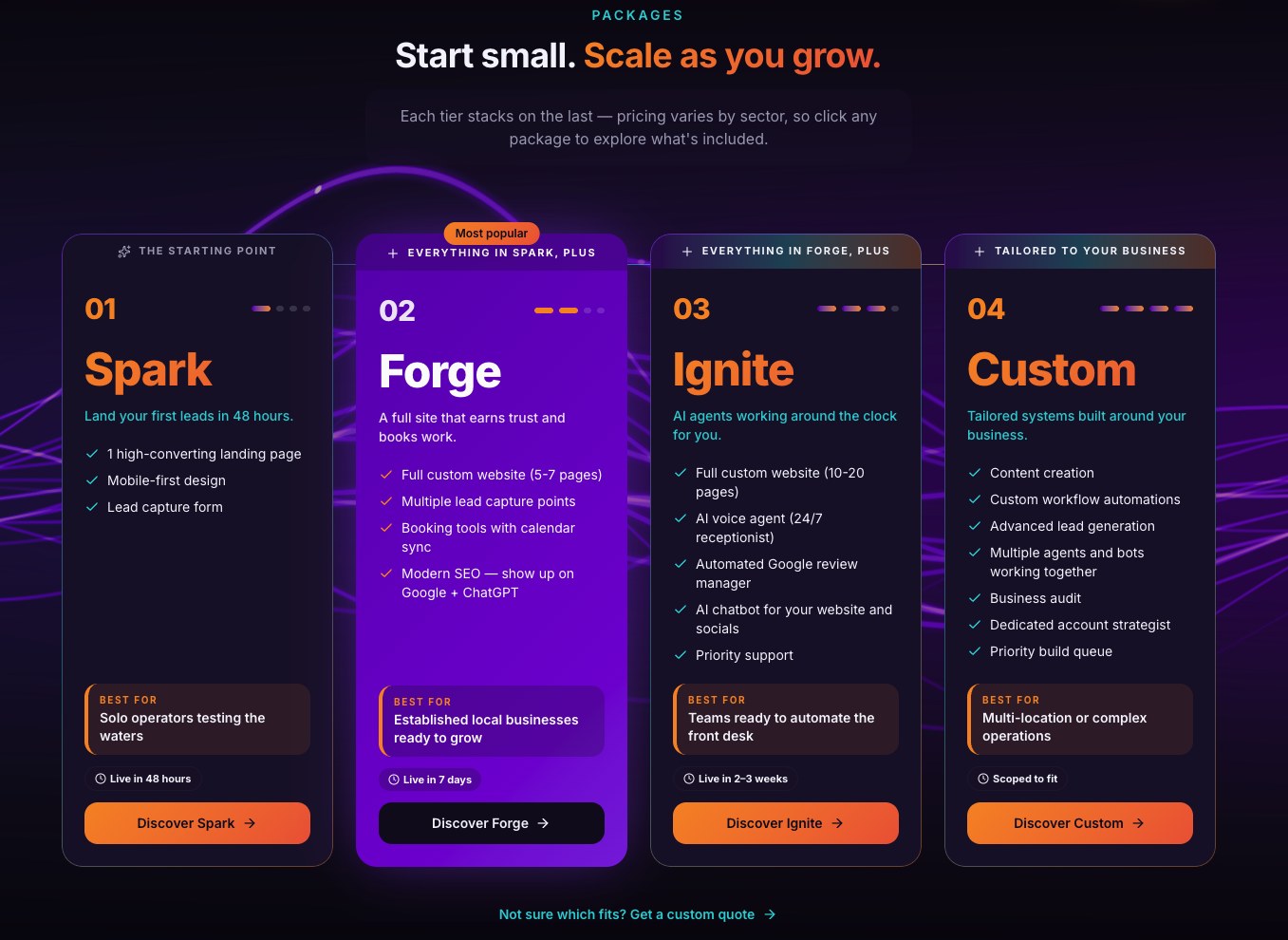
The packages page on forgelocal.app, and the page prospects spend the longest on.
Decision two: sell the number, not the AI.
A pass through the market and a few weeks of sales calls made one thing plain: owners don't respond to a concept, they respond to a number. So the site leads with one. Three inputs, live output, a dollar figure. It's the primary conversion mechanism because it converts "you're missing calls" into "you're missing this much," and the number does the selling. Yours, below.
TRY IT Change any number below. The loss updates as you type.
What are missed calls costing your business?
Three inputs, one number.
That's ~$375,000/year in lost revenue, about 12 jobs a month walking out the door.
Forge Local's 24/7 AI dispatcher answers every call, books the job, and texts you the details, typically recovering multiples of its cost.
Book a free demo →Decision three: turn one client into a pipeline.
There is no engineering handoff at Forge Local because there is no engineering team to hand off to. Client sites go from a brand read to a working build in a repeatable sequence, and the builds are structured on purpose: descriptive alt text, real heading hierarchy, content marked up so screen readers and AI search can both parse it. The web is increasingly read by machines deciding what to recommend; I design pages to be legible to them without degrading them for people.
The client's links, reviews, photos, and competitors. Who they are and who they're up against.
A one-page voice and look guide for this shop, so the build has an opinion before it has a layout.
A working single-file site the client can click before spending any money. Sold first, then built.
Fully built in Lovable, booking routed into their existing scheduler, live in days.
Applied: Elegance Barber Studio. A new Bentonville barbershop with no web presence. Mobile-first build, booking routed into their existing scheduler, structured content throughout. Built with the founder, who led implementation. Here it is on a phone, because that's how most of its visitors see it.
Honest framing. The shop's local search visibility owes plenty to its reviews and Google Business Profile; local ranking is mostly reviews and proximity. What the site demonstrably did was convert that visibility into visits and bookings, on mobile, where those customers are.
Three jobs, one designer, one season.
A visual identity built to be run by one person, and the judgment to know what needed polish and what needed to ship fast instead.
The calculator, the pricing page, and the demo-before-you-pay pipeline exist because a sale has to happen with no salesperson in the room.
No engineer to ask, so every "can we actually do this" question landed on me: what Lovable could ship, which vendor widget to trust, what a small team could maintain.
Between April and September, with no brief and no engineer, Forge Local got a visual identity built to be run by one person, a marketing site, a calculator that turns a vague problem into a dollar figure, and a four-tier offer with a pipeline behind it. Six client sites are live and paying today. The case isn't the revenue; it's that one person carried the brand, the sales tools, and the technical calls at once, alongside a founder doing the same on his side, and shipped.
Next: the project where accessibility became the whole design.